Showing posts with label Uganda. Show all posts

Thursday, February 2, 2012

LGBT Activists Protest Outside National Prayer Breakfast


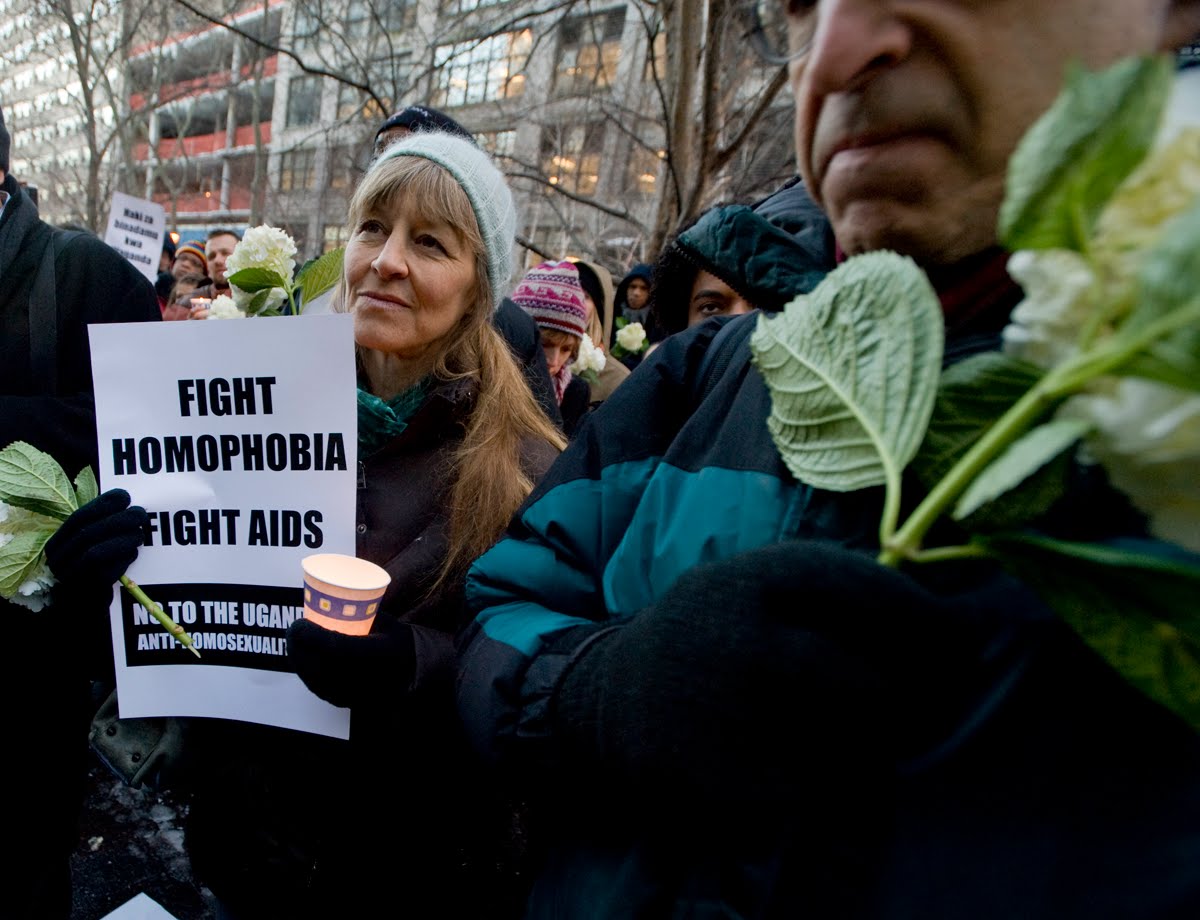
Roughly two dozen LGBT activists protested outside the National Prayer Breakfast in Washington, D.C., earlier on Thursday.

Members of GetEQUAL, Occupy Washington and the American Civil Liberties Union were among those who gathered outside the Washington Hilton to highlight what they describe as the Fellowship's global anti-LGBT agenda. While the number of activists who protested was noticeably smaller than the dozens who gathered outside the hotel last February; organizers maintained they sent a powerful message to President Barack Obama and other politicians and dignitaries who attended the 60th annual gathering.

"We’re protesting the fact that the Family is holding a National Prayer Breakfast attended by senators, representatives, the president and the vice president--specifically because of the Family and the Fellowship's role in supporting anti-gay legislation across the world," said Heather Kronk, managing director of GetEQUAL.

Activists specifically highlighted the secretive organization's ties of Ugandan Parliamentarian David Bahati, who introduced a so-called Anti-Homosexuality Bill that would impose the death penalty upon those found guilty of repeated same-sex sexual acts. This protest also comes a little more than a year after Ugandan gay activist David Kato was murdered in his Kampala home.

Thursday, November 10, 2011

Video: Kerry Praises Ugandan Gay Activist

Speaking at a Capitol Hill ceremony on Thursday, Nov. 10, U.S. Sen. John Kerry (D-Mass.) praised Frank Mugisha for his activism on behalf of LGBT Ugandans who continue to suffer systematic discrimination, violence and even death.

Kerry delivered his remarks after Ethel and Kerry Kennedy presented Mugisha with the 2011 Robert F. Kennedy Human Rights Award.

Wednesday, May 11, 2011

Ugandan lawmakers drop plans to debate "Anti-Homosexuality Bill"


Photo courtesy of Robb Friedlander

Have Ugandan lawmakers blinked?

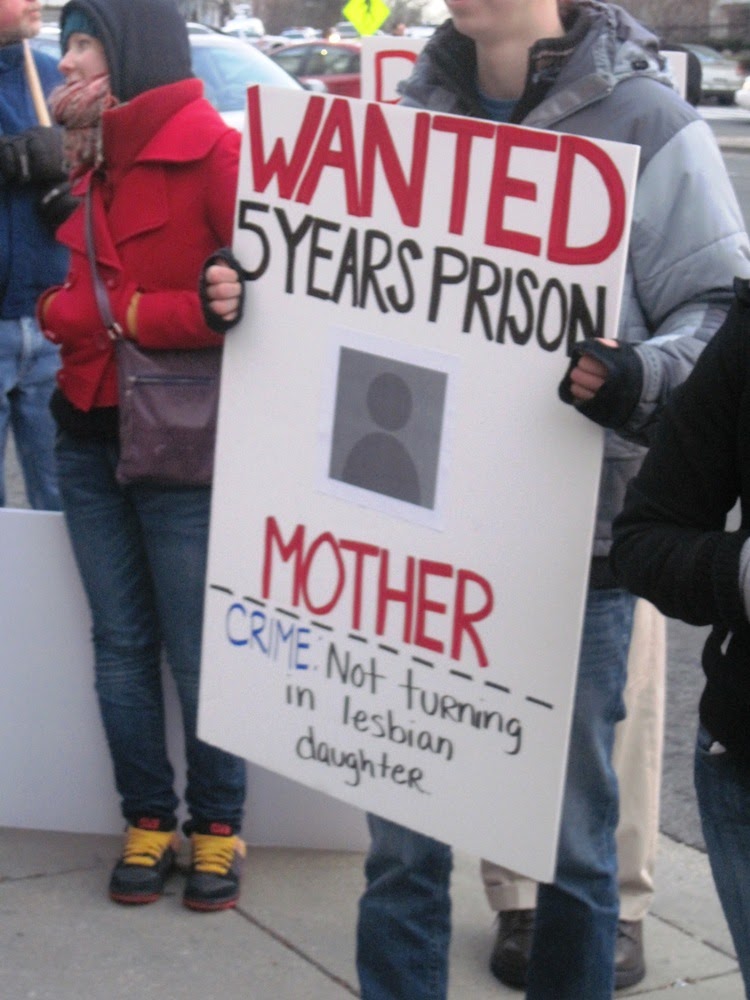
The Associated Press is reporting that Ugandan Parliamentarians have scrapped plans to debate the so-called "Anti-Homosexuality Bill" after an international outcry. Congressman Barney Frank (D-Mass.) had threatened to cut off aid to the East African country, while members of GetEQUAL protested outside the Ugandan embassy in Washington, D.C., yesterday afternoon. Amnesty International and Human Rights Watch also criticized the measure that had once called for the death penalty for anyone convicted of repeated same-sex sex acts.

"If adopted, a bill further criminalizing homosexuality would constitute a significant step backwards for the protection of human rights in Uganda," said Hilary Fuller Renner, a spokeswoman for the State Department's Bureau of African Affairs. "Respect for human rights is key to Uganda's long-term political stability and democratic development, as well as its public health and economic prosperity."

Let's hope Ugandan lawmakers finally realize that hate comes with serious consequences.

Note: It appears as though Ugandan lawmakers could vote on the "Anti-Homosexuality Bill" on Friday, May 13.

Friday, March 25, 2011

Is Uganda's anti-homosexuality bill dead?


It appears as though Uganda’s controversial anti-homosexuality bill is dead.

The New Civil Rights Movement; Blabbeando and other bloggers posted last night that Ugandan media indicated the measure, which would impose the death penalty upon anyone found guilty of repeated same-sex acts, will no longer remain on the table. The proposal sparked widespread outrage among LGBT activists inside the East African country and around the world. And gay activist David Kato’s murder in late January highlighted the plight of LGBT Ugandans.

This potential development comes only days after the United Nations' Human Rights Council voted to condemn anti-LGBT violence. President Obama also highlighted the issue in a Jan. 27 statement that urged Ugandan authorities to investigate Kato's murder.

"LGBT rights are not special rights; they are human rights," he stressed. "My administration will continue to strongly support human rights and assistance work on behalf of LGBT persons abroad. We do this because we recognize the threat faced by leaders like David Kato, and we share their commitment to advancing freedom, fairness, and equality for all."

Monday, March 7, 2011

Mongolian LGBT activists honored in Manhattan


Bushwick is probably as far away from the Mongolian steppe as one can get, but Anaraa Nyamdorj of the Mongolian LGBT Centre had one of the best sound bites this cynical journalist has heard in a long time when she accepted the International Gay and Lesbian Human Rights Commission's Felipa de Souza Award at Landmark on the Park in Manhattan on Monday, March 7.

“Long ago, our warriors conquered half of the world,” she said. “Now our warriors will go and conquer hatred. We are fierce and determined.”

IGLHRC also honored journalist Jeff Sharlet for his reporting on the links between The Fellowship and Uganda’s so-called Anti-Homosexuality Bill that would impose the death penalty upon anyone found guilty of repeated same-sex sexual acts.

Wednesday, February 9, 2011

Ugandan bishop describes gay activist's murder as "tragic and cruel"

In an open letter to the Archbishop of Canterbury and other Anglican leaders, retired Bishop Christopher Senyonjo described Ugandan gay activist David Kato's murder as "tragic and cruel."

Senyonjo, who opened St. Paul’s Centre for Equality and Reconciliation in Kampala after he retired as bishop of West Buganda a decade ago, urged Rowan Williams and his fellow bishops to do more to combat homophobia, anti-LGBT discrimination and violence.

"A loving Anglican Communion should not keep quiet when the Rolling Stone tabloid in Uganda openly supports the “hanging of the homos,” including a fellow bishop who pleads for their inclusion and non-discrimination" wrote Senyonjo. "Silence has the power to kill. We have witnessed its destruction this past week in the tragic and cruel murder of David Kato."

Senyonjo's statement comes nearly a week after New York City Council Speaker Christine Quinn and others held vigil for Kato near the United Nations. Roughly 50 people protested outside the National Prayer Breakfast in Washington, D.C., on Thursday, Feb. 3, to draw attention to what they describe as The Fellowship's connection to supporters of a Uganda bill that would impose the death penalty upon anyone found guilty of repeated same-sex acts.

Congressmembers Barney Frank [D-Mass.], Tammy Baldwin [D-Wis.], David Cicilline [D-R.I.], Jared Polis [D-Colo.] and Donald Payne [D-N.J.] are scheduled to conduct a hearing on Capitol Hill on Friday, Feb. 11, about anti-LGBT violence in Uganda.

Friday, February 4, 2011

New Yorkers hold vigil for murdered Ugandan gay activist

Hours after LGBT activists protested outside the National Prayer Breakfast in Washington, D.C., New Yorkers held vigil for murdered Ugandan gay activist David Kato near the United Nations.

Bill Alatriste sent Boy in Bushwick these shots of City Council Speaker Christine Quinn, City Councilmember Daniel Dromm [D-Jackson Heights] and others who took part.


Thursday, February 3, 2011

LGBT Washingtonians protest National Prayer Breakfast

Calling attention to what they describe as The Fellowship's connections to homophobic measures and anti-gay violence in Uganda, dozens of LGBT Washingtonians and others protested outside the National Prayer Breakfast on Thursday, Feb. 3.

Parliamentarian David Bahati's so-called Anti-Homosexuality Bill, which would impose the death penalty upon those found guilty of repeated same-sex sexual acts, remains on the table. And the protest also came less than two weeks after Ugandan gay activist David Kato was murdered in his Kampala home.

Here are some images and a clip from this morning's protest.


Sunday, January 30, 2011

Egypt, Uganda and the global village

The ongoing anti-Hosni Mubarak protests in Egypt and to a somewhat lesser extent Ugandan gay activist David Kato's murder have made headlines over the past week. And both stories raise questions mere sound bites and tweets cannot answer. Who will prove a suitable alternative to Mubarak if his regime falls? Should anti-gay American evangelicals who operate inside Uganda be held accountable for Kato's death? And should Americans even care about these and other events that take place thousands of miles away from the homeland?

My friend Paul became an American citizen at Boston's Faneuil Hall on Thursday, Jan. 27. One of the most poignant parts of the ceremony was when the judge asked the new citizens to stand after he called out their countries of origin: Angolans, Brazilians, Haitians, Jamaicans, Sierra Leoneans, British and Egyptians--yes, Egyptians--were among them. This simple, yet powerful act once again demonstrated the world is a global village. And Egypt, Uganda and other countries that continue to dominate headlines are not as far away as one may naively think.

Friday, April 30, 2010

Blogging behind closed doors

I would like to acknowledge the courage of those bloggers who often put themselves at personal risk to blog about LGBT issues in their respective countries. Several of them shared their stories with me for my Guide story that is posted below, but their work continues to provide a virtual -- and even literal -- lifeline for those who log onto their Web sites.


Khalid knows how frightening it can be to live in a country where being gay is taboo.
In 2007, Khalid agreed to appear on the inaugural cover of MK, the first gay magazine in Jordan. But the shirtless photo of the young man caused a stir after the tabloids caught wind of it. The outcry was so fierce the magazine never published.
"I was still in school at the time," Khalid told Guide magazine from his home in Amman, the capital of Jordan. "People were talking about it in my school, and they didn't know it was me at the time. It was very scary because there was no one in the whole Arab world " the Middle East " who was out in the media."
Although Khalid says he never felt his life was in danger, he did face blackmail attempts from those who threatened to out him to his parents. He hid out in neighboring Lebanon until the scandal had passed.
"It's very simple as I'm talking about it, but at the time it was very big because no other media was talking about homosexuality," Khalid said. "But now, everyone in Jordan is talking about it. That's a big step in two years."
The 21-year-old model eventually returned to Jordan, where he launched the monthly webzine My Kali to give Arab gays "a better image to look up to."
"Most of the people here look to English, European and American publications," Khalid said. "Those images don't really apply here. I just wanted to give people a different image to which [they] can relate."
Khalid, who asked that his last name not be used, is one of a growing number of gays around the world who have launched online publications. Their sites serve as virtual community centers and are an increasingly important source of news and information for gays in their own countries and others around the world.
But this online activism is often dangerous, which is why most of the bloggers quoted in this article asked that their full names not be used. Some countries in which gay bloggers work ban homosexuality. Laws designed to curb homosexual activity often carry steep prison sentences --and sometimes the death penalty. Homophobic attitudes can prove equally harmful.
GuG began to blog nearly three years ago. He wanted to document what it was like to live in Uganda, a country where gays are vilified. He lives in the capital, Kampala, which he described as "the best place to hide, where the population is densest."
His blog, with commentary about the country's leading political and religious figures, has emerged as an important source of information about gay life in Uganda. GuG has posted dozens of items about proposed legislation in his country that would impose the death penalty for homosexuality.
The BBC's call-in television show World Have Your Say invited GuG to appear as a guest in early January to discuss the situation for gay men and lesbians in Uganda. He has also spoken with other journalists around the world, but he lamented that he cannot devote all of his time to fighting the measure.
"The problem is at the moment that I have to concentrate back on bread and butter issues," said GuG.

"VISIBILITY HELPS"
In the Philippines, a piece of legislation affecting gays is a prominent topic on a blog called Bakla Ako, May Reklamo? (which translates roughly as "I'm gay, got a problem with that?") The proposed law would ban anti-gay discrimination.
AJ Matela began to blog in 2007 as a way of expressing himself. His site includes lighthearted topics ranging from discussions of gay social networking sites to videos of beauty pageants to "basically anything under the pink sun." Matela told Guide magazine that his blog continues to morph into something bigger than he originally imagined.
"Since many Filipinos are using the internet nowadays, increased visibility online helps a lot," said Matela.
The internet has become an increasingly popular place for gays to not only connect with each other, but to learn about gay-specific news, as well as government-sanctioned raids, arrests and other actions.
Mario Martinez launched his blog, Diario de un Gay Guanaco (Diary of a Gay Salvadoran), in 2007 as a way to speak out against the media's coverage of gay issues in El Salvador. He introduces himself to his readers as a journalist who is "tired of our society's hypocrisy."
In a recent post titled "It's not so bad to be a faggot if you are a priest," Martinez discusses the sex scandals that have rocked the Catholic Church in El Salvador and the rest of the world.
"These are my experiences as a homosexual in this third-world and machismo country," Martinez explains.
Some Salvadorans have criticized his website, but Martinez says he has never felt threatened. Other gay bloggers around the world have faced far more serious threats.
Death threats forced Predrag M Azdejkovic, a gay blogger in Serbia, to delete some of his online postings. Azdejkovic, who is also the president of a gay community center in Belgrade, said he has received threatening emails from a neo-Nazi group.
He said some of his countrymen are uncomfortable with the fact he blogs for a national media outlet, but his posts are popular among young Serbs.
"Others have a problem that a gay person has a space on the national network to write," he said.
Censorship is another issue many bloggers confront.
Ricky secretly updates Gay Boy Weekly from his home in Kuwait City. His most recent posting celebrates his blog's anniversary with a picture of fireworks. Ricky routinely posts items about gay-specific news throughout the Persian Gulf, but his main challenge is remaining one step ahead of government censors.
"I'm happy that my blog is not yet blocked," he joked. "What makes me worried is that the government can say that writing about gay rights is against the law."
Mazaj, who has written Mood for Gay Syria for four years, posts information about gay-friendly coffee shops, hammams (traditional steam baths), cruising areas and hotels in Damascus, Aleppo and other Syrian cities. He said he has not faced the same difficulties that Ricky confronts in Kuwait.
"The Syrian government is a secular government," Mazaj said. "I know for sure that they know about all the places gay people go to. They don't care unless people start to demand a change in laws or ask for rights. Then it might be dangerous, but so far there have been no major troubles with the government here about the blog."
Gay bloggers can face violence from their fellow countrymen.
Cuppatea maintains A Colourful Life of a Gay Kenyan from his home in Nairobi. He blogs about daily life for gay Kenyans. Cuppatea says he identifies people in his blogs by their initials or pseudonyms to protect them from being outed to their families, friends and employers.
In 2007, these fears became a reality after an anti-gay group tried to out people by posing as gay men on Facebook. The Kenyan authorities eventually stepped in, but not before the group outed three of Cuppatea's acquaintances.
"Some straight people tried to shut me down, but I stressed freedom of speech on the internet," he said.

SHAPING THE CONVERSATION
Even though statistics indicate roughly a quarter of the world's total population already accesses the Web, the internet continues to gain traction as more people, especially in the developing world, continue to log on. Internet World Stats reports 74 percent of North Americans and 52 percent of Europeans have regular access to the internet, compared to 28.3 percent of Middle Easterners, 19.4 percent of Asians and 6.8 percent of Africans.
Most gay bloggers who spoke to Guide magazine said they hope their blogs play an important role in shaping the conversation about gay issues in their countries.
"I would like to think that my blog, among other gay blogs in Kenya, has people see that we exist, we are there and we walk amongst them living our lives as they would theirs," Cuppatea said.
Matela agreed.
"I would like to believe that my blog helps shape the perception about homosexuality in Philippine society," he said.
Khalid remains hopeful My Kali will continue to challenge homophobic attitudes in Jordan and throughout the Middle East.
"People are easily influenced; you give them something, they read it and they admire it," he said. "I'm trying to change the very close-minded people here and the perspective of what homosexuality is. And I am trying to break that stereotypical image."
As for Ricky, he describes himself as "one small voice from the Gulf area." But he notes that he received notes from concerned readers after he stopped blogging for a couple of months.
"I didn't think that people would read what I wrote, but I discovered that there are huge numbers of people who like what I write," Ricky said. "I feel so good that they can actually hear my voice."

Thursday, December 17, 2009

BBC's coverage of Uganda's 'anti-homosexuality bill' sparks controversy

The British Broadcasting Corporation has responded to the growing controversy over a question a debate on one of its programs about a Ugandan bill that would impose the death penalty against anyone found guilty of homosexuality in the East African country.

Africa Have Your Say asked its listeners to debate the question: "Should homosexuals face execution." Peter Horrocks, director of the World Service, responded to the controversy earlier today.

"The reaction from part of our audience was very strong and [we] do feel in retrospect the headline taken out of context was too stark and [we] do apologize for any offense that was caused to people, but it was an absolutely legitimate debate to have," he said. "We were having that debate clearly because that's the question the Uganda Parliament is having."

Indeed, Ugandan lawmakers are scheduled to debate the so-called "anti-homosexuality bill" in Kampala tomorrow. People have taken to the streets in Chicago, San Francisco and other cities around the world to protest the proposed law.

British activist Peter Tatchell opined the BBC should encourage debate over the draconian bill, but he added he feels editors should have approached it differently.

“I think it perfectly reasonable for the BBC to host a debate about the current Ugandan Anti-Homosexuality Bill, but not in the terms that it was framed,” Tatchell said.

Horrocks again defended the debate he said he feels Africa Had Your Say encouraged.

"This question is being posed directly in the Ugandan Parliament and there were plenty of people who took part in the program who were supportive of it," he said. "It is a legitimate subject for debate, but clearly the way that you handle something like that with different sensitivities in different societies [over] the ways the questions are posed is something we need to be careful about."

A journalist's basic obligation is to pose difficult questions--including those that make their sources and those who hear, read or watch them uncomfortable or even angry. The idea Uganda could potentially sanction executions of gays and lesbians is a disgusting and shameful stain on the East African country. The BBC and other media outlets, however, have a responsibility to encourage an honest and open debate about the bill and the very real impact it could have on gay and lesbian Ugandans. And this obligation must trump any potential controversy and outrage that could result from such an exchange.